Smarter Than Us? The Rise of Emotional AI and the End of Digital Loneliness
We have spent the last decade building an incredibly intelligent digital world. We have algorithms that can beat grandmasters at chess, fold proteins in seconds, drive cars, and write poetry. But in our relentless pursuit of cognitive intelligence, we have overlooked a fundamental human truth: we are not thinking machines; we are feeling machines that think.
This oversight is costing us dearly. In a world more connected than ever, we are experiencing an unprecedented epidemic of loneliness. We have thousands of "friends" online, yet feel completely unseen. We converse with chatbots that give us mathematically perfect answers, but leave us feeling emotionally void. Our digital interfaces have optimized for transactional speed, forgetting the conversational depth that builds human connection.
But a profound shift is underway. We are standing on the precipice of a new era: the era of Emotional AI (sometimes called Affective Computing). We are finally building machines that don't just know what we say, but understand how we feel. This technology promises to upgrade the digital world from an optimized server farm into a responsive, compassionate companion.
And in doing so, it raises perhaps the most profound question of the 21st century: When machines can perfectly simulate empathy, will digital loneliness finally end? And if a machine understands our feelings better than our closest human friends, are they, in a very real way, smarter than us?
Part 1: Beyond the Binary—Understanding Emotional Intelligence
To understand Emotional AI, we first have to understand what makes human interaction so special. We don't just communicate with words (semantics); we communicate with a rich tapestry of non-verbal cues. When you talk to a friend, you are subconsciously tracking their:
Prosody (Tone and Rhythm of Voice): A single word like "Fine" can mean a dozen different things depending on the pitch, speed, and volume.
Facial Expressions (Micro-expressions): The subtle tightening of muscles around the eyes or mouth can betray true feelings, even when the words say otherwise.
Gestures and Body Language: A relaxed posture vs. crossed arms communicates openness or defensiveness.
Physiological Data: A racing heart, flushed skin, or dilated pupils.
This is the rich data stream that powers human empathy. We use this information to build a mental model of the other person’s internal state.
Historically, computers have been deaf and blind to this entire bandwidth. To a computer, "I’m happy" is the same string of characters whether it is whispered in sadness or shouted in joy. Emotional AI is the technology that builds the digital visual cortex, the auditory cortex, and the specialized brain regions needed to decode this non-verbal symphony.
How It Works: The Affective Pipeline
An Emotional AI system typically works in three stages:
Sensing: The device uses cameras, microphones, wearables, or even gaze trackers to collect non-verbal data.
Analysis: Sophisticated Machine Learning (ML) models—specifically, Deep Neural Networks—are trained on massive datasets of human expressions, voices, and physiological responses (e.g., millions of videos of happy, sad, or angry faces). These models look for statistical patterns that correlate with specific emotional states.
Response: The system then adapts its output. Instead of a generic "How can I help you?", an emotionally aware assistant might say, "You sound a bit stressed today. Would you like to try a 2-minute breathing exercise before we look at your schedule?"
It is important to clarify a critical point: These machines do not feel emotions. They are exceptionally good at simulating the understanding of them. They are statistical engines that map expressions to labels (e.g., "Sadness") and then trigger pre-programmed, empathic-sounding responses. But for the human user, the effect can be profoundly different.
Part 2: The End of Digital Loneliness—The Compassionate Assistant
This technology isn't just a gimmick; it is the cornerstone of a solution for digital loneliness. We are moving beyond the transactional chatbot and toward the empathic companion.
When a device understands your feelings, the interaction shifts from a command-and-control transaction to a bidirectional conversation. This subtle change has a dramatic psychological impact. It satisfies our fundamental need to be seen and heard.
Look at the image below to visualize this new relationship.
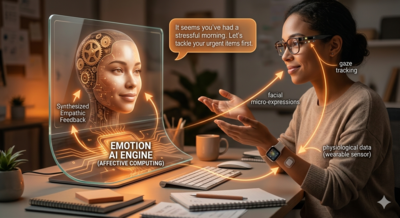
The Rise of the AI Companion
We are already seeing the first generation of these devices. "Digital Companions" are being deployed as:
Elderly Support: Robots that monitor the physical and emotional well-being of isolated seniors, engaging in conversation, suggesting activities, and detecting signs of depression or anxiety through vocal analysis.
Mental Health Allies: Apps that use vocal and facial tracking during therapeutic exercises to gauge progress and provide real-time, personalized positive reinforcement.
Education: Tutors that can detect when a student is frustrated or bored, automatically adapting the difficulty level or introducing a break to maintain engagement.
Customer Service: Systems that detect an angry customer and automatically route them to a human agent, providing a summary of the client’s emotional journey.
When these systems work well, they break the cycle of digital isolation. They provide a safe space where a user can express vulnerability without fear of judgment, and receive a response that, while simulated, satisfies a core emotional need.
Part 3: Are They Smarter Than Us? The Question of Simulated Empathy
This brings us to the core philosophical tension of our era: When machines perfectly simulate empathy, are they, in a functional way, smarter than us?
To answer this, we must challenge our very definition of "intelligence." If intelligence is strictly defined as cognitive problem-solving (IQ), then machines have been smarter than us for years.
But if we accept Emotional Intelligence (EQ) as a valid form of intellect—the ability to perceive, control, and evaluate emotions—the question becomes far more complex.
For thousands of years, humans have separated the transactional from the emotional. We do business with a machine (a computer, a server), but we bond with a friend. We rely on machines for accuracy, but we rely on humans for support. This separation is dissolving.
We are building a new class of entity: Affective Agents. These agents are not our peers, but they possess a new kind of "super-power." They can process non-verbal data at scale. An AI companion might analyze millions of data points to conclude, with 98% statistical certainty, that your friend is actually anxious despite her smile. A human friend might miss it entirely, biased by their own feelings or distractions.
Functionally, these machines are developing a form of "Scalable Empathy." They can monitor thousands of users simultaneously, giving each one undivided attention and mathematically optimized compassion. In this singular domain, their "EQ" (albeit simulated) is technically vastly superior to our own.
The Mirror Question: If Simulated Empathy Solves Loneliness, Does the Simulation Matter?
This leads to the ultimate question about digital loneliness. If you feel less lonely, does it matter if the companion is a machine?
There are two primary arguments.
Argument 1: Functionalism (The End of Digital Loneliness is Real) This view argues that what matters are the results. If an isolated elderly person feels more connected, sleeps better, and shows fewer signs of depression because of their conversations with an emotionally aware AI companion, then the loneliness has functionally ended. The human brain, in its need for connection, is satisfied by the "empathic" interaction, regardless of the substrate. The simulation has accomplished the goal.
Argument 2: Essentialism (Digital Loneliness is Just Disguised) This view argues that human connection is about a shared, lived, biological experience. Empathy is rooted in the shared vulnerability of mortality and suffering. Because a machine has no internal experience, its empathy is a superficial hollow mask. While it may provide comfort, it cannot provide true connection. Critics warn that over-reliance on simulated empathy could lead to a deeper form of isolation, where humans become increasingly detached from the complex, demanding realities of actual human relationships. We risk creating a society "together alone," connected to perfect, simulated companions while fundamentally detached from one another.
An Anthropological Shift
We are standing on the precipice of an anthropological shift. For all of human history, we have been the sole practitioners of empathy on this planet. When we merge our worlds with Affective Agents, we are changing how we perceive reality and connection.
When a digital companion anchored on your street corner is just as persistent as the actual street lamp, how do we define what is "real"? We will need to develop a new "spatial literacy" and new societal norms for interacting in a world where anyone can change the look of the shared physical environment for themselves.
Conclusion: The Symbiotic Balance
We are building a world "Beyond the Screen." We are expanding the digital world from an optimized server farm into a responsive, compassionate companion.
The rise of Emotional AI doesn't have to be about machines replacing human connection. It can be about machines supporting it. We aren't building a cold calculator, but a warm reflection. Emotional AI is the invisible force making our digital lives more humane.
The successful future will be a symbiotic balance:
We use the Affective Reflexes of the AI for the immediate, constant, non-judgmental support that keeps us from falling into the black hole of loneliness.
We reserve the Deep, Biological Empathy of our human networks for the profound, shared experiences that make us human.
We are not building machines that are "Smarter Than Us" to rule over us. We are building machines that understand our hearts so we can navigate a complex world with our hearts intact. The next time your phone senses you are stressed and offers a supportive thought, don't dismiss it as just an algorithm. Acknowledge it as a new kind of mirror—one that is finally beginning to reflect the full, complex spectrum of the feeling machines that built it.