Beyond the Screen: How 6G and Spatial Intelligence are Finally Merging Our Two Worlds
Take a look around you. Chances are, a significant portion of your world is currently viewed through a rectangle. Whether it's the smartphone in your hand, the laptop on your desk, or the TV on your wall, we have spent the last two decades funneling our digital lives through flat, glowing screens. These screens are remarkable windows, but they are still windows—interfaces that separate "us" from "it."
We exist in a rich, three-dimensional physical reality. Our digital data, however, still largely exists in a two-dimensional, siloed space. This fundamental disconnect is about to end. We are standing on the precipice of the "Post-Screen Era."
This shift isn’t driven by a single gadget, but by the convergence of two massive technological pillars: 6G connectivity and Spatial Intelligence. Together, they are building a bridge that will allow digital information to finally step out of the screen and integrate seamlessly into our physical environments. We aren't just going "online" anymore; our world is becoming the interface.
Part 1: The New Nervous System—Why 5G Was Just the Warm-Up, and 6G Is the Main Event
To understand where we are going, we must briefly look at where we are. 5G was a necessary evolution. It gave us faster downloads, lower latency, and the ability to connect more devices (the Internet of Things). It made streaming 4K video on a bus possible. But 5G was still designed primarily to connect devices to the internet.
6G, targeted for commercial rollout around 2030, is being designed to connect the physical world to the digital world.
The leap from 5G to 6G isn’t just about speed; it's about a fundamental change in capability. While 5G operates in milliseconds, 6G aims for microsecond latency (less than 0.1 milliseconds). This is critical. For the digital and physical worlds to merge, there can be no perceptible delay. If you turn your head in a mixed-reality environment, the digital overlay must move instantly. Any lag breaks the illusion and causes motion sickness.
Furthermore, 6G introduces capacities that 5G could only dream of:
THz (Terahertz) Spectrum: 6G will tap into incredibly high frequency bands, opening up massive data highways. This allows for data transfer speeds that are 100 times faster than 5G, potentially reaching 1 Terabit per second (Tbps).
Network as a Sensor: This is the wildest part. 6G networks won't just transmit data; they will collect it. The radio waves themselves can act like radar, mapping the environment, detecting the presence and movement of people and objects, and even sensing air quality, all without dedicated cameras or sensors.
Pervasive AI: 6G won't just "use" AI; it will be AI. Artificial Intelligence will be embedded into every node of the network, optimizing traffic, predictive maintenance, and managing the core function of merging realities in real-time.
In short, 6G is the ultra-responsive nervous system that our new combined world requires.
Part 2: Spatial Intelligence—Giving Computers Eyes, Depth, and Context
If 6G is the nervous system, Spatial Intelligence is the visual cortex and the brain's understanding of context.
For a computer to merge its world with ours, it must first understand our world. Historically, computers have struggled with this. A traditional camera sees a flat image; it doesn't understand that the object in front of it is a "chair" that can be sat upon, or that the wall behind it is a "surface" that can display data.
Spatial Intelligence changes this. It is the ability of an AI system to perceive, reason about, and interact with the 3D physical environment. It combines several key technologies:
Computer Vision & Object Recognition: Moving beyond just seeing pixels to identifying objects and their functions (semantic understanding).
SLAM (Simultaneous Localization and Mapping): Allowing a device to map an unknown environment and keep track of its own location within that map in real-time.
Depth Sensing (LiDAR/ToF): Using light and lasers to create highly accurate 3D point clouds of a room.
Contextual Awareness: Understanding that a specific location (e.g., your kitchen table) has different data needs than another location (e.g., your office desk).
When a device possesses Spatial Intelligence, it doesn't just display data "on" a screen; it anchors data "in" the world. It knows that the persistent digital sticky note you left on the refrigerator should stay exactly there, even when you leave the house and come back. It understands that a virtual character should walk around the coffee table, not through it.
Part 3: The Synergy—Visualizing the Post-Screen Era
The true magic happens when these two forces combine. 6G provides the instantaneous, high-bandwidth data pipe, and Spatial Intelligence provides the 3D context. The screen is no longer the interface; the world is.
Look at the image below to visualize how this is already taking shape.
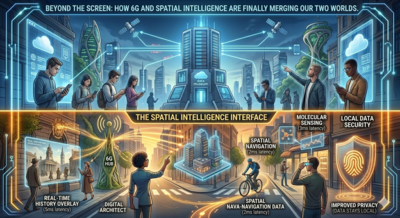
This AI-generated image brilliantly captures the core of our thesis. It shows a futuristic user, connected by subtle, glowing streams of light representing the ultra-fast 6G network. Notice that there is no traditional screen. Instead, the user is interacting with Spatial Intelligence itself.
The environment (in this case, a futuristic lab) has become the canvas. Data isn't just displayed; it is spatialized. Complex molecular structures and holographic data interfaces are anchored in the 3D space, wrapping around the user and responding to their gaze and gestures. This image beautifully captures the transition from "watching a screen" to "existing within the data."
Part 4: The Impact—Redefining How We Work, Play, and Live
The merging of our two worlds won't just give us cool new gadgets; it will fundamentally restructure key areas of human activity.
4.1 The Death of the Office and the Rise of the "Holoport"
We’ve all experienced the fatigue of 2D video calls. They lack presence. In the 6G/Spatial Intelligence era, the "Zoom call" will be replaced by Holoportation.
Using 6G's massive bandwidth, your 3D volumetric image can be transmitted instantly and "projected" into your colleague's physical office, and vice versa. You aren't watching them on a monitor; they are sitting across the desk from you. Spatial Intelligence ensures that eye contact is natural and that you can both interact with the same holographic product model floating between you. This will make true, presence-based remote work indistinguishable from being in the same room.
4.2 Education: Stepping Inside the Lesson
Forget reading about ancient Rome. In a spatial world, the classroom is ancient Rome. Students wearing lightweight AR glasses can walk through a digitally reconstructed Forum, watch Cicero deliver a speech, or manipulate a virtual, exploded-view model of the human heart anchored in the center of the room. Learning shifts from passive observation to active, spatial exploration.
4.3 Entertainment: From Spectator to Participant
Movies and games will no longer be confined to a screen. A horror game might detect the architecture of your own living room, causing a virtual monster to peek around your actual sofa. In sports, you could place a 3D, miniaturized holographic view of the entire football match on your coffee table, allowing you to view any play from any angle, live, thanks to 6G cameras mapping the stadium in real-time.
4.4 Advanced Manufacturing and Healthcare
In a smart factory, a technician wearing spatial glasses can see a faulty machine with a digital overlay showing repair instructions, schematics, and the real-time temperature of internal components, all fed by the local 6G network. In healthcare, a surgeon performing complex surgery can have the patient's pre-op 3D MRI scan digitally overlaid onto the patient's body in real-time, acting as a spatially anchored roadmap.
Part 5: The Road Ahead—Challenges and the Anthropological Shift
This future is incredibly exciting, but the path is not without significant hurdles.
Compute Power: Merging realities in real-time requires immense local and edge compute power, demanding major breakthroughs in mobile chip efficiency.
Spectrum and Infrastructure: Rolling out THz spectrum networks is technically complex and extremely expensive, requiring massive new infrastructure deployment.
The Privacy Paradox: For Spatial Intelligence to work, your devices must constantly map your private spaces. A 6G network that "senses" people and objects raises profound surveillance concerns. We must build robust "Privacy by Design" frameworks.
An Anthropological Shift
The biggest challenge, however, might be psychological. For thousands of years, humans have separated the "symbolic" (stories, maps, data) from the "physical." The symbolic lived in books, on canvases, and finally, on screens.
When we merge these worlds, we are changing how we perceive reality. When a digital ghost anchored on your street corner is just as persistent as the actual street lamp, how do we define what is "real"? We will need to develop a new "spatial literacy" and new societal norms for interacting in a world where anyone can change the look of the shared physical environment for themselves.
Conclusion
We are moving "Beyond the Screen." The rectangles that have dominated our digital lives for two decades are about to dissolve. They aren't going away, but they are expanding to fill the entirety of our three-dimensional world.
The convergence of 6G’s ultra-responsive, sensing nervous system and Spatial Intelligence’s contextual understanding is building the final bridge. We are about to enter an era where data has context, where presence transcends location, and where our physical and digital realities are not two separate worlds, but one unified, interactive, and infinitely richer whole. The window is closing, and we are finally stepping through.