The Future in Your Pocket: How Edge Computing is Changing Everything
In the grand narrative of human technological progress, we have always moved between two poles: centralization and decentralization. We went from massive mainframe computers that filled entire rooms to personal desktops, then back to the massive "Cloud" data centers of the 2010s. Now, a new revolution is quietly unfolding—one that brings the power of the digital world closer to us than ever before.
Enter Edge Computing: the technology that is decentralizing the internet and making our world smarter, faster, and more private.
The Problem with the "Cloud"
For the past fifteen years, the "Cloud" has been the undisputed king. We’ve become accustomed to the idea that our data travels to a massive warehouse full of servers thousands of miles away, gets processed, and flies back to our devices. It feels instantaneous when you are just sending an email or uploading a photo to social media.
However, as we move into the era of robotics, self-driving cars, and virtual reality, "fast enough" isn't good enough anymore. The physical distance between your phone and a data center in Virginia or Singapore creates latency—a delay in data transmission. In the world of high-speed tech, those milliseconds of travel time are becoming a major hurdle.
If a self-driving car sees a pedestrian, it cannot wait 200 milliseconds for a cloud server to tell it to brake. It needs to "think" and "act" in 2 milliseconds.
Visualizing the Shift: Cloud vs. Edge
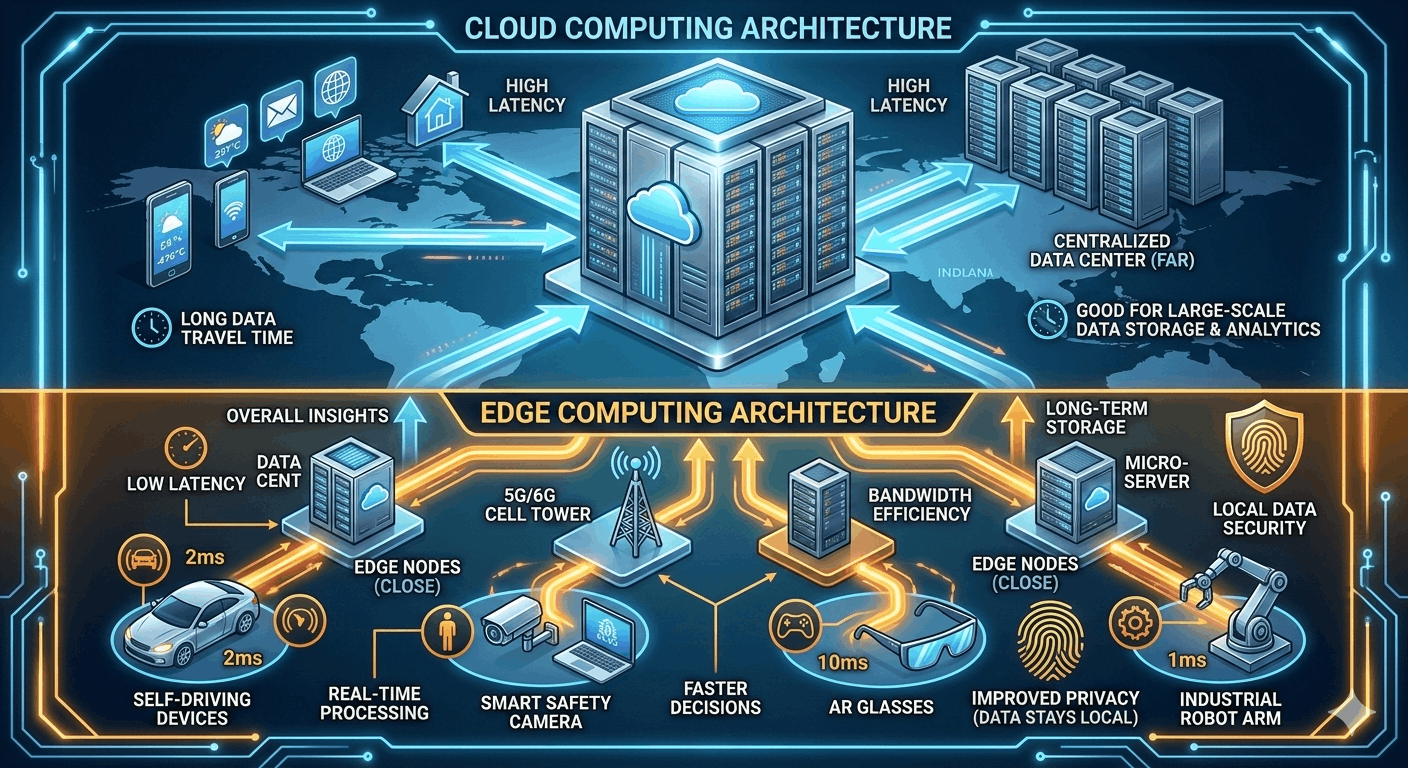
To understand this transformation, look at the architecture below. It illustrates the difference between sending everything to a distant "brain" versus having "reflexes" right where the action happens.
As the diagram shows:
Cloud Architecture (Top): Data travels long distances, resulting in high latency (100-200ms). This is perfect for big data storage and long-term analytics.
Edge Architecture (Bottom): Processing happens at "Edge Nodes" (like 5G towers or local micro-servers). This slashes latency to under 10ms, enabling real-time responses for cars, cameras, and VR headsets.
Why Edge Computing is a Game Changer
1. Zero Latency for Real-Time Actions
The most obvious benefit is speed. By moving the "brain" closer to the "body," we enable technologies that were previously impossible.
Self-Driving Cars: They process gigabytes of sensor data per second. Edge computing allows them to detect obstacles and navigate complex intersections without relying on a shaky internet connection.
Gaming & VR: Cloud gaming services like Xbox Cloud or NVIDIA GeForce Now rely on Edge nodes to ensure that when you press "jump," your character moves instantly, preventing the dreaded "lag."
2. Enhanced Privacy and Security
One of the biggest concerns with the Cloud is that your sensitive data—facial recognition patterns, medical records, or private conversations—must be sent over the internet to a third-party server. With Edge Computing, your data can be processed locally. Your phone can recognize your face without ever sending your biometric data to a server. As the diagram notes, "Data Stays Local," which significantly reduces the risk of data breaches.
3. Bandwidth Efficiency
The world is becoming flooded with "Smart" devices (The Internet of Things). If every smart lightbulb, security camera, and refrigerator in a city sent 4K video streams to the Cloud 24/7, the internet would crash under the weight. Edge computing filters this data. A security camera can "watch" the footage locally and only send a tiny alert to the Cloud if it actually sees an intruder.
The Symbiosis: Cloud and Edge Working Together
It is important to note that the Edge is not replacing the Cloud; they are partners.
The Edge handles the immediate: "Brake the car now!" or "Unlock this door!"
The Cloud handles the complex: "Analyze the driving patterns of 1 million cars to improve next year's software update."
Think of the Edge as your body's reflexes (like pulling your hand away from a hot stove) and the Cloud as your long-term memory (learning that stoves are hot).
The Road Ahead: 5G and Beyond
The fuel for this revolution is the rollout of 5G and 6G networks. These high-speed cellular networks act as the highway that connects our devices to Edge nodes. As these networks expand, we will see "Smart Cities" where traffic lights talk to cars, and doctors perform remote surgeries using robotic arms with zero delay.
We are moving away from a world where we "go onto the internet" to a world where the internet is woven into the very fabric of our physical surroundings.
Conclusion
The "Future in Your Pocket" isn't just a faster smartphone; it's a smarter world. Edge Computing is the invisible force making our technology more responsive, more secure, and more human. By bringing the power of the data center to the "edge" of our physical lives, we are finally stepping into a future where technology works at the speed of thought.